
Britain has spent centuries finding ways not to say the word “condom”. French letter, johnny, rubber, love glove: most of these are jokes, polite dodges or quiet digs at other countries rather than anything literal. And the word “condom” itself? Nobody actually knows where it came from. The famous tale of a “Dr Condom” at the court of Charles II is almost certainly a myth.
Where does the word “condom” come from?
The honest answer is that no one is certain. The word first appears in print in England in the early 1700s, but its true root has never been settled. Etymologists have floated Latin condus (a vessel or store), the Latin verb condere (to hide or store away), an Italian word linked to “glove”, and a Persian term for a length of intestine used for storage. None of these has ever been proven, and serious references still list the origin as unknown.
Two stories get repeated as fact and should not be. The first is the legend of a “Dr Condom” (sometimes an earl or a court physician) who supposedly invented or recommended the device for Charles II. There is no record of such a person, condoms were already in use long before Charles took the throne, and the tale only surfaces around 1709. Most authorities reject it outright. The second is that the word comes from the French town of Condom. That is folk etymology with no real evidence behind it. Both make great pub trivia and neither is true.
British slang for condoms
| Term | Meaning and likely origin | Era |
|---|---|---|
| French letter | Dated euphemism, probably mixing the old British habit of pinning anything risqué on the French with the folded, envelope-like look of early sheaths. | Mid-1800s on |
| Johnny | Informal British slang of uncertain origin. The stories tying it to a real person are repeated everywhere but never verified. | 20th century |
| Rubber | Named after the material of early mass-produced condoms. The product changed; the nickname stuck. | 1800s on |
| Sheath | A plain metaphor: a cover or case. One of the older euphemisms still in clinical use. | 1700s on |
| Prophylactic | Clinical word for something that prevents disease, long used to avoid saying “condom” out loud. | 1800s on |
| Something for the weekend | The classic British barber’s question, a coded offer that let nobody actually name the product. | 20th century |
| Love glove / raincoat | Jokey modern metaphors, both built on the idea of a protective cover. | Late 20th century on |
French letter versus English overcoat
Here is the part most people miss. While the British were calling it a “French letter”, the French were calling it capote anglaise, the “English overcoat” or “English hood”. Each side hung the embarrassing thing on the other. It fits a wider European habit of giving anything morally awkward a foreign name, so you never have to own it yourself. The condom got caught in a cross-Channel blame game that lasted well over a century.
What condoms are called around the world
| Place | Term | Literal sense |
|---|---|---|
| France | capote anglaise | English overcoat / hood |
| Germany | Pariser | “the Parisian” |
| Brazil | camisinha | “little shirt” |
| Spain | preservativo | “preservative / protector” |
| Italy | preservativo / cappuccio | “preservative” / “little hood” |
| Japan | kondomu | a direct loanword, not a euphemism |
The pattern repeats across languages: either a polite clinical word like “preservative”, or a homely metaphor about a little garment that covers something up. Germany even kept the cross-border joke alive by naming it after Paris.
When the brand becomes the word
A few names got so big they almost turned generic. In Britain that is Durex; in the United States, Trojan. It happened partly because, for decades, you could barely advertise condoms openly. Brands and shops leaned on euphemism instead: “for your protection”, “rubber goods”, “for disease prevention”, or the barber’s quiet “something for the weekend, sir?” The coded language did the selling so nobody had to say the unsayable.
Myth versus fact
| Myth | Fact |
|---|---|
| “Condom” was named after Dr Condom, physician to Charles II. | No such person can be found in the records. The story only appears around 1709 and most authorities reject it. |
| The word comes from the French town of Condom. | A popular folk etymology with no real evidence behind it. |
| “French letter” means the French invented the condom. | It is a euphemistic nickname built on national stereotyping, not a record of origin. |
| “Capote anglaise” proves the English invented it. | It is simply the French version of the same cross-border joke. |
| “Johnny” definitely comes from one named person. | The origin is uncertain and the named-person stories are unverified. |
| Early condoms were always rubber. | Before rubber and latex they were made from animal gut, bladder and linen. |
We took the opposite approach
For centuries people went to absurd lengths not to name the thing. At Kissy Bang Bang we did the reverse and put the joke right on the wrapper. If you fancy the full backstory, our history of condoms covers the lot, from linen sheaths to latex. And if you would rather write your own punchline, you can design your own from scratch.
British slang, printed on the wrapper
Half the terms in the table above have ended up on a Kissy Bang Bang wrapper. These are printed in London on fully CE-marked, ISO 4074 tested condoms, and you can mix any six from the funny condoms collection.
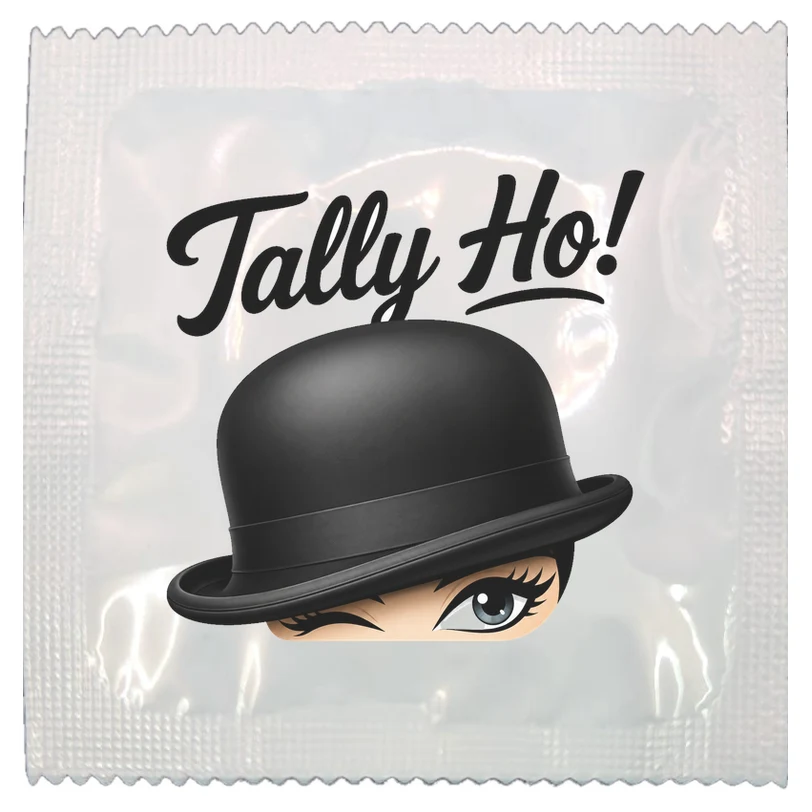 Tally Ho!£1.66
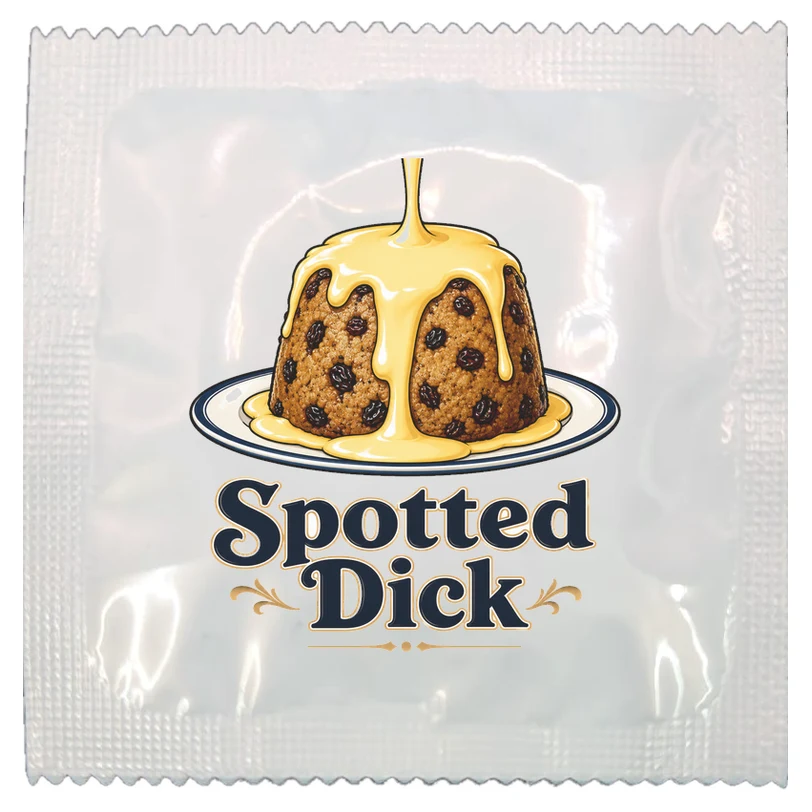 Spotted Dick£1.66
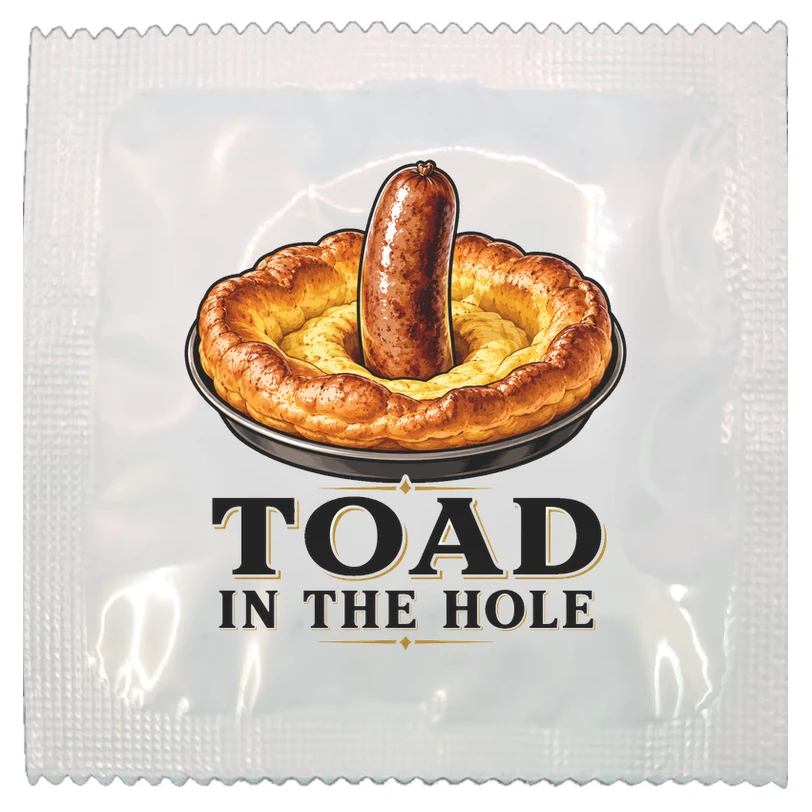 Toad in the Hole£1.66
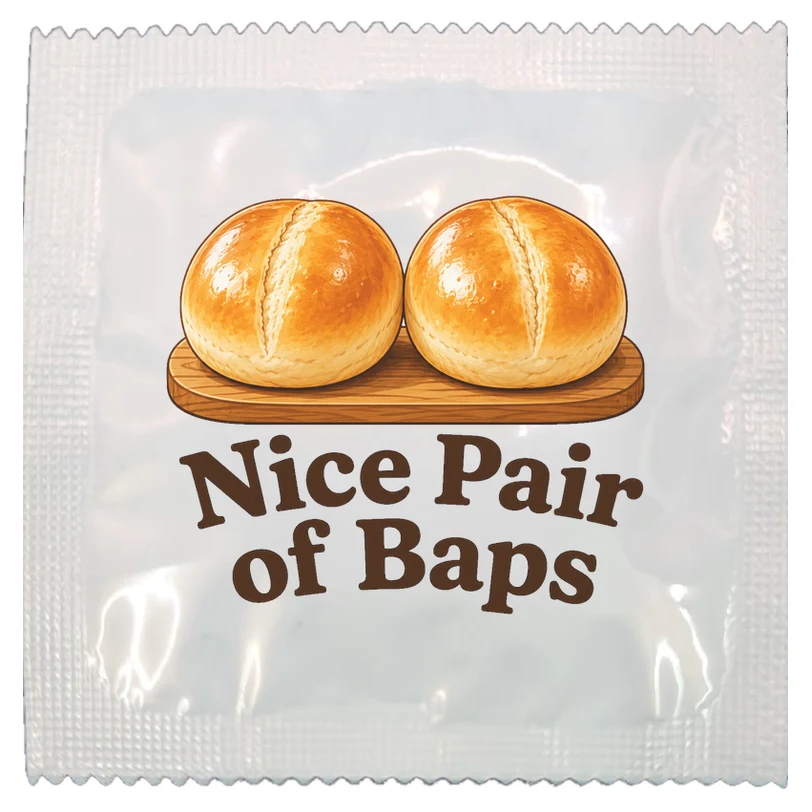 Nice Pair of Baps£1.66
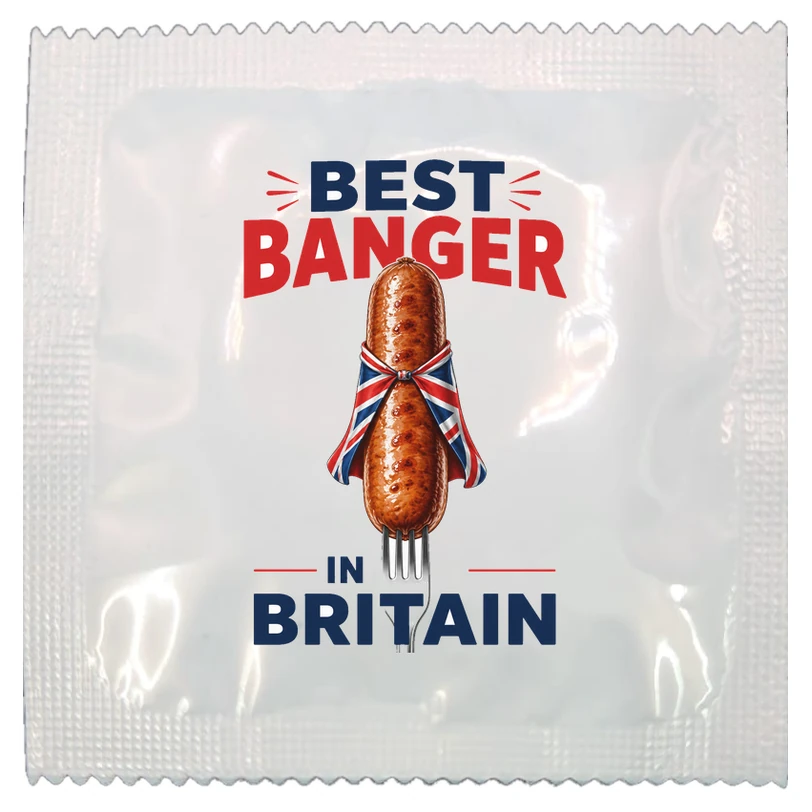 Best Banger in Britain£1.66
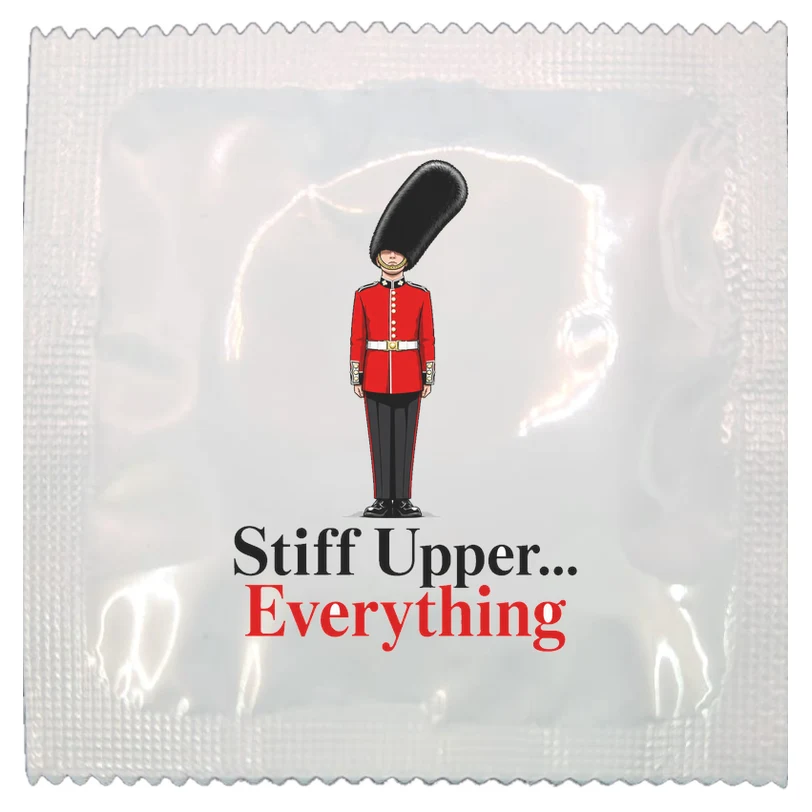 Stiff Upper… Everything£1.66
See the full funny condoms range.
Frequently asked questions
Why is a condom called a French letter?
What does capote anglaise mean?
Was there really a Dr Condom?
Where does the word “condom” come from?
Why do people call condoms “rubbers”?
Why are condoms called johnnies?
What do British people call condoms?
Why do different countries name condoms after rival nations?
What did advertisers say when they could not say “condom”?
Sources: Oxford University Press, “The word condom” (2022); Etymonline, “condom”; “The story of the condom”, PMC / NIH (2013); University of Edinburgh, “French letters”; Wikipedia, “History of condoms”. Disputed origins are flagged as disputed throughout.
Related guides